Course description
Course Outline
Introduction to Asthma Management in Primary Care
Prevalence, impact, and challenges of asthma in the UK
Role of healthcare professionals in primary care in managing asthma effectively
Latest Recommendations and Guidelines on Asthma Diagnosis
Overview of current diagnostic criteria and assessment tools
Interpretation and application of diagnostic guidelines in primary care
Case studies and practical exercises for diagnosis
BTS/SIGN Guidelines and Standards
Detailed exploration of the BTS/SIGN guidelines
Understanding the evidence-based recommendations and their practical application
Case-based discussions on applying the guidelines in primary care settings
Treatment Options and Inhaler Devices
Overview of pharmacological treatment options for asthma
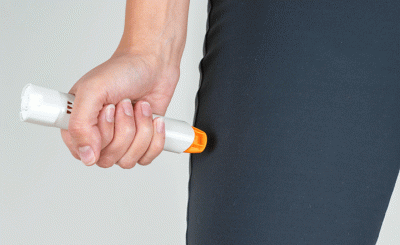
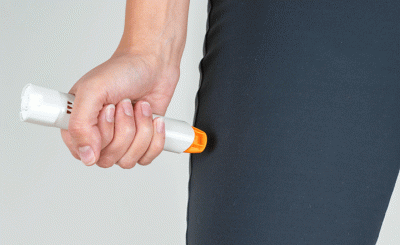
In-depth analysis of different inhaler devices and their proper use
Practical demonstrations and hands-on training with inhaler devices
Advantages and Differences Between New Inhaler Devices
Evaluation of the latest inhaler devices on the market
Comparison of different inhaler types (e.g., dry powder, metered-dose, smart inhalers)
Factors to consider when selecting inhaler devices for individual patients.
Acute Asthma: Identifying and Managing Patients at Risk
Risk factors and clinical features of acute asthma
Strategies for early identification and intervention
Emergency management and referral guidelines
Preventing Exacerbations: Treatment Options and Care Plans
Overview of preventive treatment strategies
Development of personalized care plans for asthma patients
Patient education and self-management techniques
References and Further Reading
British Thoracic Society (BTS)/Scottish Intercollegiate Guidelines Network (SIGN). (2021). British guideline on the management of asthma. Retrieved from https://www.brit-thoracic.org.uk/quality-improvement/guidelines/asthma/
National Institute for Health and Care Excellence (NICE). (2020). Asthma: diagnosis, monitoring and chronic asthma management. Retrieved from https://www.nice.org.uk/guidance/ng80
Asthma UK. (2021). Asthma facts and statistics. Retrieved from https://www.asthma.org.uk/about/media/facts-and-statistics/
Royal College of General Practitioners (RCGP). (2021). Clinical Priority: Respiratory. Retrieved from https://www.rcgp.org.uk/clinical-and-research/our-programmes/clinical-priorities/respiratory.aspx
Public Health England. (2021). Asthma: Action Plan for England 2021-2026. Retrieved from https://assets.publishing.service.gov.uk/government/uploads/system/uploads/attachment_data/file/994742/Asthma_Action_Plan_for_England.pdf
Scottish Intercollegiate Guidelines Network (SIGN). (2019). British guideline on the management of asthma: Quick reference guide. Retrieved from https://www.sign.ac.uk/media/1882/quick-reference-guide-btssign-158.pdf
Primary Care Respiratory Society UK (PCRS-UK). (2021). Asthma resources. Retrieved from https://www.pcrs-uk.org/asthma-resources
NHS Digital. (2021). Quality and Outcomes Framework (QOF) – Prevalence, Achievements, and Exceptions Report 2020/21. Retrieved from https://digital.nhs.uk/data-and-information/publications/statistical/quality-and-outcomes-framework-achievement-prevalence-and-exceptions-data/quality-and-outcomes-framework-qof-prevalence-achievements-and-exceptions-report-england-2020-21